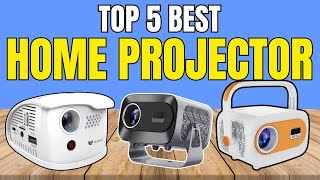

Projectors have become an essential part of home entertainment, transforming living rooms, backyards, and even workspaces into immersive viewing environments. With rapid advancements in projector technology, 2025 brings some exciting models that blend stunning image quality, bright color performance, and versatile features. Whether you’re looking for a top-tier home theater setup, a budget-friendly option, or a portable projector for on-the-go entertainment, this guide covers the best choices this year along with key factors to consider before buying.
Why a Projector? The New Wave of Home Entertainment
Projectors are no longer bulky, dim, and complicated devices. Today’s models offer crystal-clear 4K resolution, vibrant colors, and even fast refresh rates perfect for gaming. They can project massive images—sometimes over 300 inches diagonally—that dwarf traditional TVs. Plus, many support popular HDR formats to boost picture depth and realism.
Whether curling up for a movie night or hosting an outdoor sports event, projectors provide flexibility and scale that TVs struggle to match. However, choosing the ideal projector involves weighing many technical details, so let’s start with the best models on the market.
Top Projectors to Watch in 2025
Hisense C2 Ultra: The Best Overall Projector
The Hisense C2 Ultra takes the crown this year as the premier projector for home use. It produces a breathtaking 4K image that can stretch up to 300 inches, offering users a true cinema experience. One of its standout features is compatibility with all major HDR standards, including HDR10, Dolby Vision, and HLG, making colors and details pop vividly.
For gamers, the C2 Ultra includes an HDMI 2.1 port and impressively low input lag, especially in its ultra-fast 240Hz mode, which ensures smooth, responsive gameplay. The RGB laser light source delivers about 3,000 ANSI lumens, providing bright and sharp images even in moderately lit rooms.
The built-in audio system is another highlight—it offers two 10W speakers plus a powerful 20W subwoofer that fills medium-sized rooms without requiring external speakers.
Drawbacks: While the Hisense C2 Ultra dazzles in image and sound quality, it comes with a high price tag around $2,500, and its built-in Vidaa OS smart platform still lacks some polish compared to Android TV or Google TV. Many users opt to pair it with external streaming devices like Apple TV for the best app experience.
JMGO N1 Ultra: Best Budget 4K Projector
Close behind the Hisense is the JMGO N1 Ultra, often available for around $1,000—making it a remarkable value in the 4K laser projector segment. This short-throw model uses a unique triple-laser setup combining red, green, and blue lasers to deliver vibrant, accurate colors covering 96% of the DCI-P3 gamut and full sRGB.
Its brightness reaches approximately 2,100 ANSI lumens, suitable for most indoor environments with some ambient light control. Gamers will appreciate its respectable low input lag (around 28ms in gaming mode), though it lacks the ultra-high refresh rate of the C2 Ultra.
Audio performance is solid for a projector of its size, with built-in speakers adequate for small rooms. For better sound, it supports eARC output to connect to soundbars or AV receivers.
Considerations: The JMGO N1 Ultra has fewer ports and a slower operating system compared to competitors, which might limit connectivity and app responsiveness.
LG CineBeam Q (HU710PB): Best Portable 4K Projector
If portability is your priority without sacrificing 4K resolution, the LG CineBeam Q shines as a compact option at under $1,000. It’s roughly the size of a small cube and easy to transport for watching movies or shows on the go.
Despite its small size, the CineBeam Q uses a triple-laser system for bright, colorful images covering 98% of DCI-P3. However, it only outputs around 500 ANSI lumens, so it’s best suited for dark environments. Its contrast ratio is decent for the class, enhancing picture depth.
The audio system is minimal, with just a 3W speaker, so pairing with external Bluetooth speakers is recommended for better sound quality.
Limitations: The projector’s brightness and audio output won’t replace a proper home theater setup but make it very appealing for travel and casual use.
Other Noteworthy Projectors
Many other brands and models like BenQ HT2060, Epson Home Cinema 3800, Xgimi Horizon Ultra, and Optoma GT2100HDR have impressive merits in brightness or contrast, and some provide excellent value for those on tighter budgets or seeking specific features like ultra-short throw or advanced gaming support.
Key Features to Consider When Buying a Projector
Brightness (Lumens)
Brightness is a major factor impacting where and how you use your projector. Measured in ANSI lumens, this metric lets you know how well the projector performs in different lighting conditions. For home use in dim or dark rooms, 1,000-2,000 lumens usually suffice. For outdoor or rooms with more ambient light, aim higher.
Color Gamut and Accuracy
A projector’s ability to reproduce a wide range of colors results in more lifelike and immersive images. Look for at least 90% coverage of the sRGB color space and ideally over 90% of DCI-P3 for rich cinematic visuals.
Contrast Ratio
Contrast significantly influences image depth. High contrast means deeper blacks and better shadow details. A projector with balanced brightness and high contrast produces a more mesmerizing picture, especially for movies.
Resolution
Native 4K projectors provide the sharpest details and are perfect for large screens. While 1080p is acceptable for distant viewing, 4K is the future-proof standard for crisp movies, detailed static images, and gaming.
Light Source
Projectors often use lamps, LEDs, or lasers. Laser projectors generally provide brighter images and longer lifespans (up to 30,000 hours), but they cost more upfront. Lamps may be bright but wear out faster and are less energy efficient.
Connectivity & Ports
Number and types of ports affect how easily you connect gaming consoles, streaming devices, and sound systems. Look for HDMI 2.1 ports for gaming, USB options for media playback, and eARC or optical audio ports if you want to attach quality speakers.
Built-In Speakers
While many projectors have built-in sound, the quality varies widely. Higher wattage speakers or subwoofers offer richer sound, but serious audio enthusiasts should plan to use external sound systems.
How Projectors are Tested
Professional reviews evaluate projectors in real-world scenarios, measuring brightness using light meters, checking color accuracy with colorimeters, and assessing contrast by comparing white and black image luminance. Input lag is tested by timing the delay between external input and on-screen display, which is crucial for gaming.
Subjective analysis includes watching movies and playing games to judge image fluidity and sound quality, while also testing various ambient lighting conditions and screen types.
Summary
In 2025, projectors have surged ahead to offer incredibly bright, richly colorful, and versatile options that suit a wide range of needs. The Hisense C2 Ultra leads the pack for those craving a top-tier, immersive home theater experience with vast image sizes and excellent gaming features. The JMGO N1 Ultra strikes a remarkable balance of performance and affordability, making 4K laser projection more accessible. If portability is key, the LG CineBeam Q packs 4K quality into a tiny, travel-ready design.
When selecting a projector, prioritize brightness to suit your room, ensure vivid color and strong contrast for stunning images, and check connectivity for the devices you’ll use. Don’t overlook audio quality; sometimes pairing with external speakers transforms the viewing experience.
Careful research and matching the right projector to your lifestyle and space will guarantee fantastic performance that turns any viewing into a show-stopping event.
Frequently Asked Questions (FAQs)
Q1: What brightness level do I need for a home projector?
For indoor use with some ambient light control, aim for projectors with at least 1,000 to 2,000 ANSI lumens. If you plan to use the projector in daylight or rooms with multiple windows, higher brightness improves picture visibility.
Q2: How important is input lag for gaming on a projector?
Input lag measures how long it takes for your controller’s actions to show on screen. Low input lag (under 30ms) is essential for fast-paced gaming to ensure responsiveness. Some projectors, like the Hisense C2 Ultra, offer special modes to reduce lag further.
Q3: Are built-in projector speakers usually sufficient for good sound?
Built-in speakers vary widely; many projectors have basic speakers adequate for small rooms but lack depth and volume. For richer audio, using external speakers or soundbars through HDMI eARC ports enhances the experience significantly.
Q4: What is the difference between native and supported resolution in projectors?
Native resolution is the actual pixel count the projector can display, while supported resolution includes the input signal formats it can handle. To get sharp images, focus on the native resolution—true 4K projectors have native 4K, not just support for 4K input.
Q5: Is laser or lamp light source better for projectors?
Laser light sources generally last longer (up to 30,000 hours), offer brighter and more consistent colors, and work better in ambient light compared to traditional lamps. However, lasers are usually pricier upfront.
This comprehensive guide aims to arm you with the knowledge to choose the perfect projector in 2025 for entertainment, gaming, or portability—turn your space into a stunning visual playground.

Leave a Comment